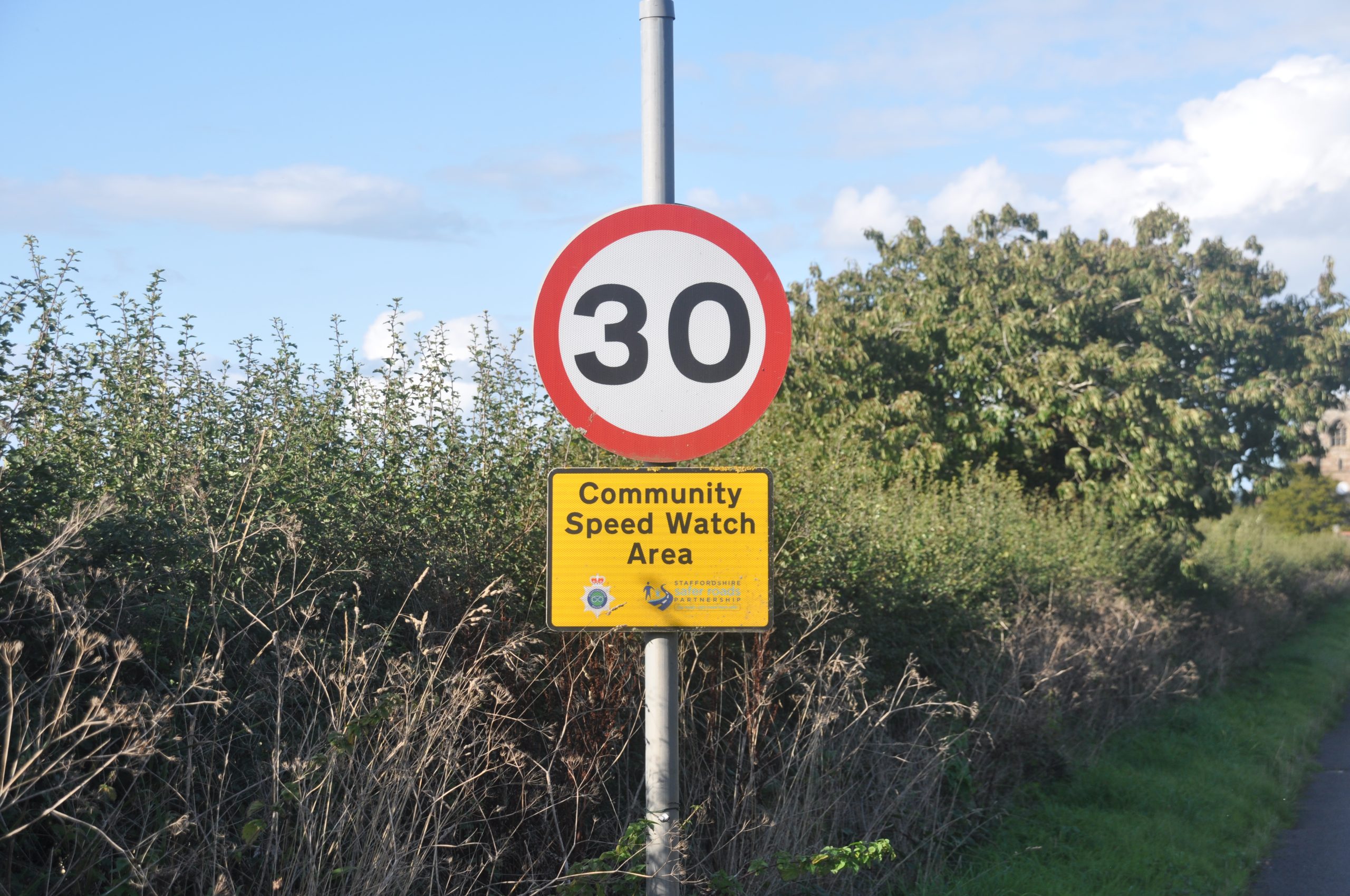

What is the Community Speed Watch? It is a three way road safety partnership between local residents, the local council (or town council), and the Police. The aim, is to raise awareness of speed and other driving issues like the non wearing of seatbelts, or the use of mobile phones whilst driving, and to educate local drivers to improve their skills and overall road safety.
Contrary to popular belief, community speed watch groups are not local busy bodies reporting drivers to the Police, but, a properly organised Police activity, whereby the session is organised by the volunteers at any time they like between dawn and dusk on behalf of the local Police, and are effectively working for the Police at an Administrative volunteer level thereby releasing traffic officers to deal with other tasks. A volunteer has no Police powers.
Community speed watch areas are only only available in 20mph, 30mph and 40mph areas. Community speed watch groups do not monitor faster speeds of roads.
I have been a community speed watch volunteer for Staffordshire Police for a number of years, and now I help to organise sessions in my local area. Sessions are usually conducted in pairs, however a third volunteer or a trainee may join in to get experience.
Training
In order to become a volunteer, you need to meet up with the Safer Roads Officer who is employed by the Police, and have a background check and complete some training. This is so that there is consistency and the data they receive back is accurate and the Police are able to act upon it.
I did my training with the Police at the local Fire Station. It sounds odd, but the Police sometimes use training rooms at any facility that is at a locality closer to the volunteers, and this made sense for everyone at the time.
You are taught about how to use the equipment, limitations of the equipment, how to complete the paperwork, what to check for, how to run a session, and when not to run a session, ie during bad weather, or during times of limited visibility. You are also instructed on how to deal with members of the public, who may not appreciate your road safety efforts.
I completed my training, and began by shadowing another group as a third community speed watch volunteer, as mentioned above. I then transitioned to my own group with other volunteers.
Equipment
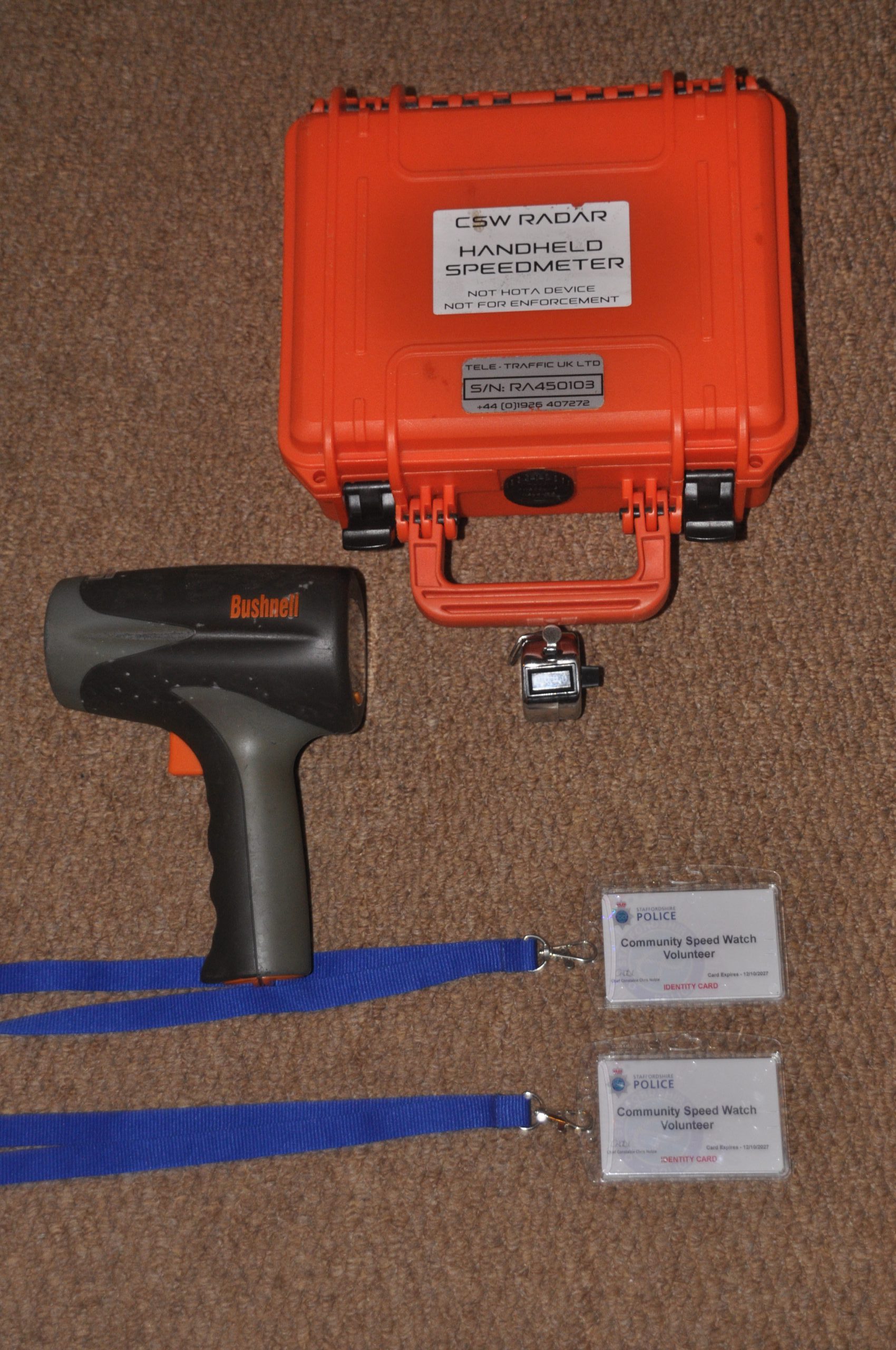
The local council, or town council, will provide the volunteer group with some basic equipment. Obviously, a basic radar gun, in our community speed watch group we have a Bushnell radar gun, traffic counter, clipboard, stationery, high viz jackets and spare batteries.
Unlike most community speed watch groups, we are a group who are active all year round, performing two to three one hour sessions per week, so we tend to get a year out of a set of 2 x C type dry cell batteries before we request new batteries from the local town council.
In addition, the Police will provide you with the official volunteer identities that you must wear along with your high viz vests when doing a session because you are representing them. On the rear of the identities, not shown for security, they have individual badge numbers, and they have an expiry date.
Organising a Session
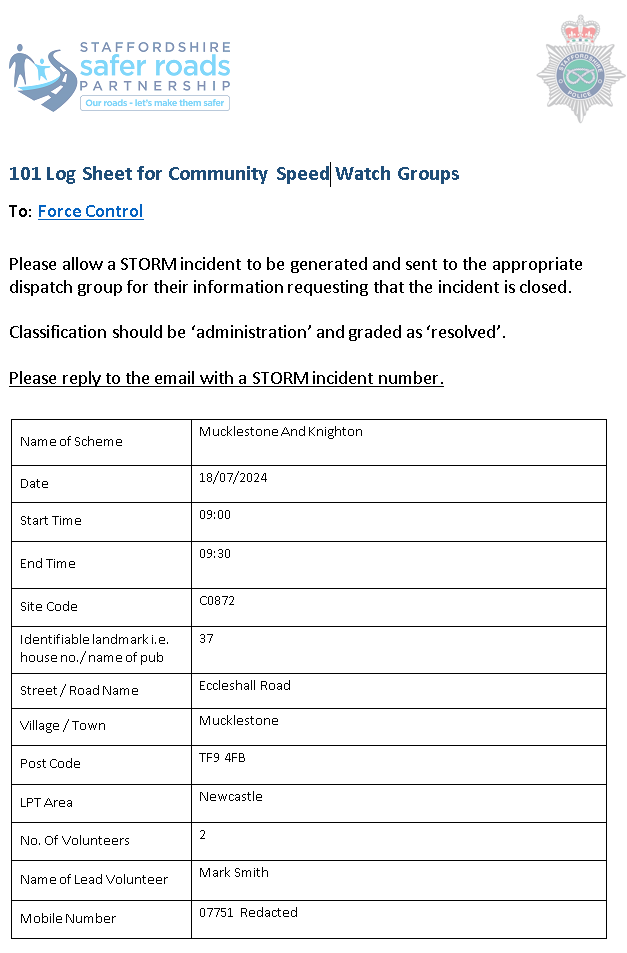
The Police need to know when you are going to perform a session. This is for a number of reasons, they need to know for insurance purposes, your security, for operational purposes, and sometimes, they may want to join you. This has happened from time to time whereby the local PCSO has joined us on a session, and we have recorded that fact on our paperwork along with his Police Constable identity.
In order to organise a session, the Police need the community speed watch organiser to submit a form to Force Control 24 hours before the session commences. On this form, there is the site identifier, a unique code identifying where the session will take place. This location will have already been checked by the Police, and a risk assessment done as to it’s suitability both from a safety of the volunteers, and also a visual impact viewpoint. All sites will have a yellow “Safer Roads Partnership” warning sign visible at the beginning of the area.
Community Speed Watch Sessions
The radar gun needs to be checked before and after every session, and this is done with the tuning fork provided. The radar gun will pick up the oscillations of a tuning fork, and will indicate a speed. Individual guns have in their calibration the speed that it should display. This check is performed before and after each session, and the volunteers certify that this check has been carried out.
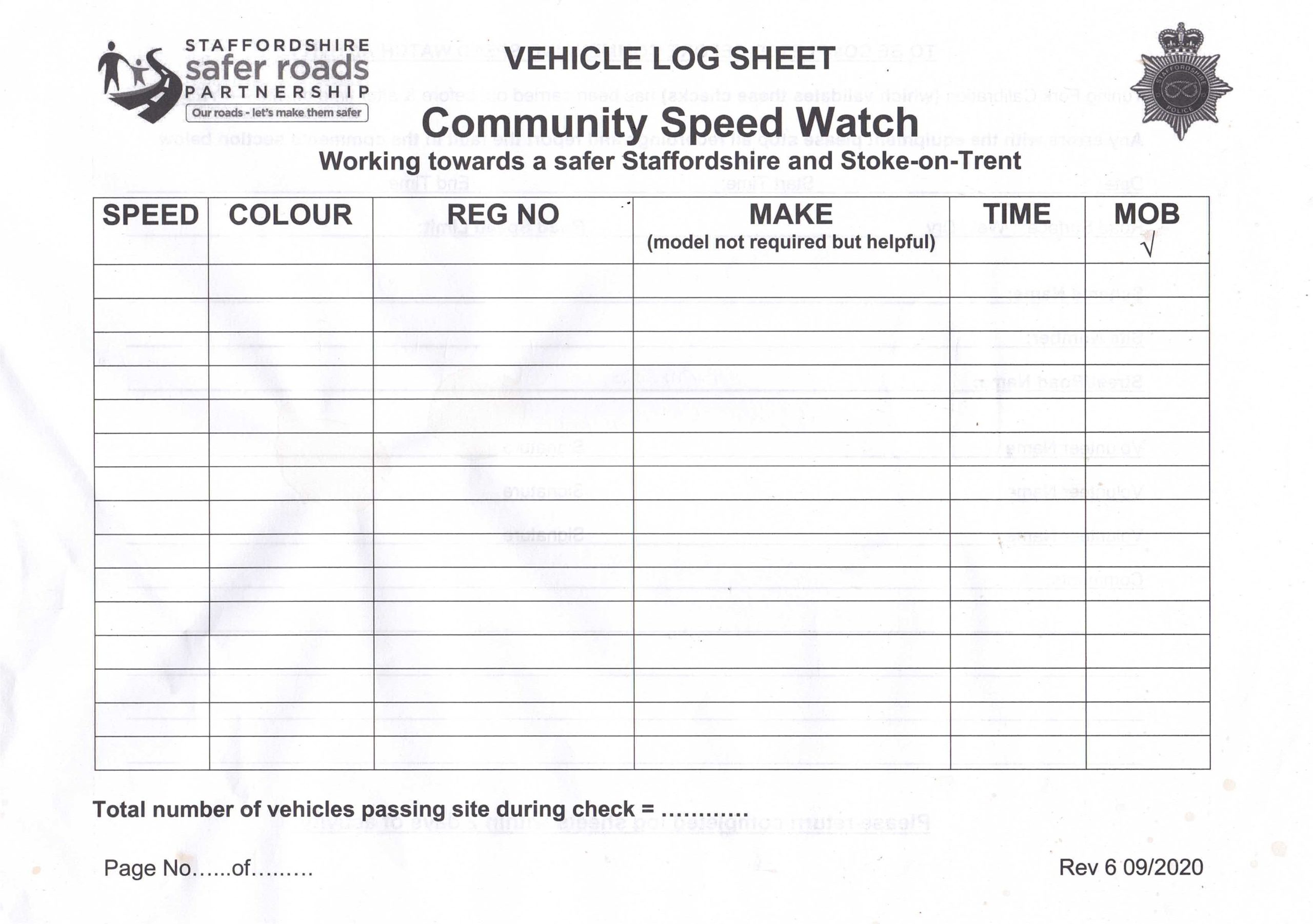
As you are working in pairs, one person operates the radar gun, and the other one the recording onto the sheet of paper on your clipboard. I never liked pointing a gun at someone, so I tended to do all of the admin, and left the pointing of the gun to the other volunteer, who is so fast on the draw with that gun..!
We tried to be lenient, in that in our 30mph zone, we only recorded motorist who exceeded 37mph or more, or never attempted to slow down. Some passed us, and then thinking they were safe sped up to over 50mph, not realising that we can radar them from behind, and operate on a two way road in both directions.
Not only do we check for speed, but, there are additional columns on the form to record anyone not wearing a seatbelt, or using a mobile phone. Amusingly, I remember once recording someone with excessive speed, stop alongside us, right in the middle of the lane, with the engine still running, lowering their passenger window to remonstrate with us, telling us he was going to report us to the Police. He got his phone out to take a photo of us, while still in the driving seat with the engine running. We simply ticked the “using a mobile phone” box, as he now was.
Submitting Results
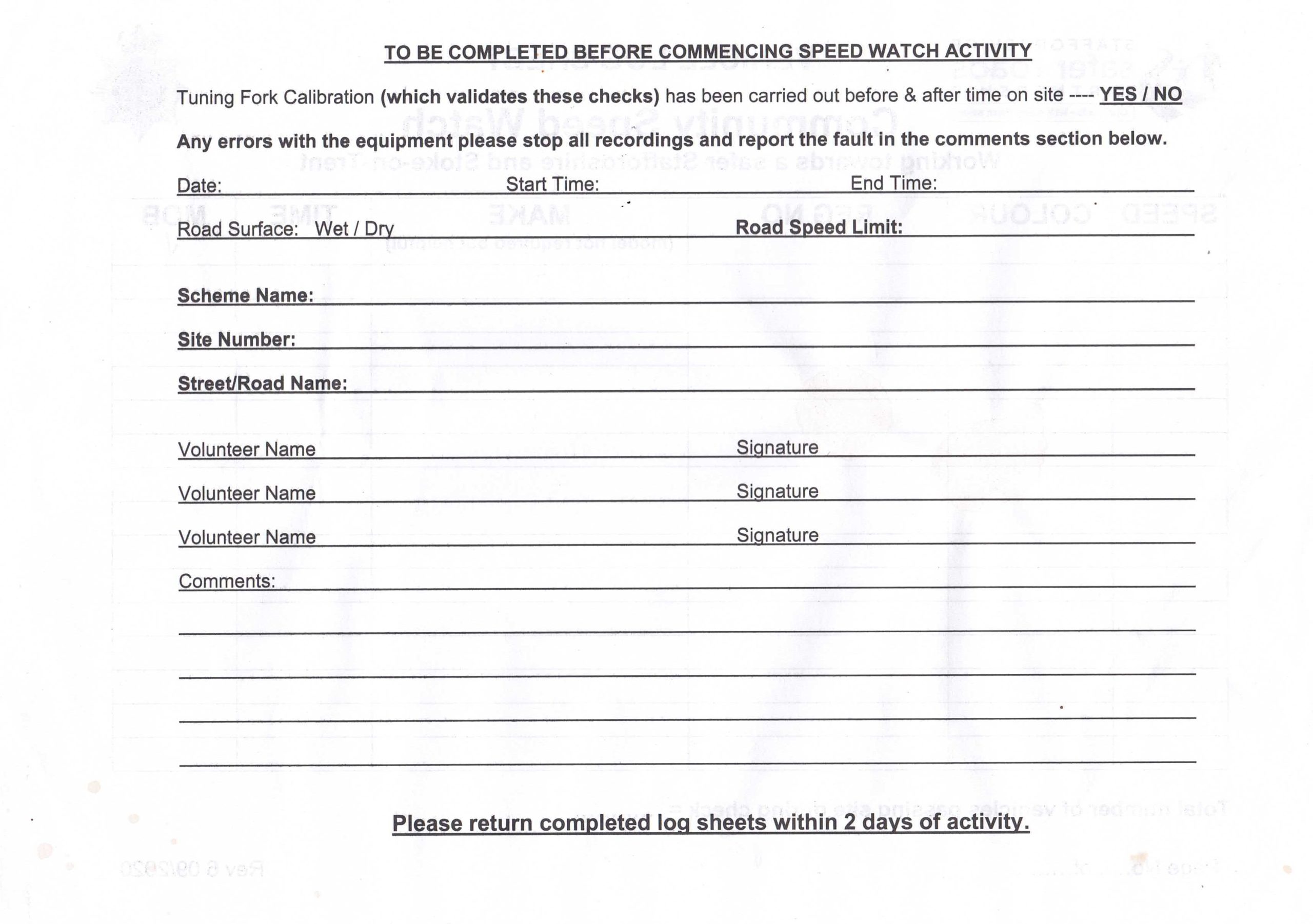
We have pre-printed free post envelopes in order to send our signed and certified results off first class. When the Police receive these results, one of the checks that they perform is to see if the make, model and colour tallies with the registration mark of the vehicle, and if it is taxed and insured. They can also log other data too, like the traffic volume at that time of the session, and also percentages of offenders, and comparisons with our other sessions, and other sessions being completed across the forces area.
Police Warning Letters
The Police have the power to issue warning letters to the drivers in order to educate them about their speed. If they persist in driving too fast within a 12 month period, another more sternly worded warning letter will be sent. Third, or more times, may involve a knock at someone’s door for a quiet word in their ear regarding their driving standards and conduct.
Road Safety Impact
All community speed watch groups can receive the overall statistics of the community speed watch efforts across the Police force’s area, and it will show the impact that collectively the volunteers are having to accident statistics in areas where excessive speed is an issue.
Conclusion
Is it worth it? Yes and no. I better start with the “No” answer first. If your area is a trunk road with a 40mph zone, then frankly I would expect a higher proportion of drivers passing through, so educating them to a lower speed on that road may have limited success, as education takes time to sink in and overcome habit. However, if most of the traffic is likely to be local commuting traffic, I would say though experience “Yes”, most of the traffic does start to flow at a slower and safer speed, although it will take a while for that education to overcome habit. There will always be the prolific speeder who will continue, you’re never going to stop that, but, if you can help local children by educating the majority of drivers, then that is a good thing.
Should every zone be a lower zone like they have done in Wales with their 20mph zones. No, I think that may frustrate drivers, and impatient and frustrated drivers may be more of a hazard. It is early days for Wales, but, I think through experience, a combination of zones, lower where there is a school, higher elsewhere. This would be a nice compromise. It would be nice to see those statistics mentioned above for Wales, comparing say three years before the blanket 20mph and three years after. I bet there is not a significant reduction in statistics. Perhaps one for a future article.
Setting Up Community Speed Watch
In order to set up a community speed watch group in your area, you need to search your local Police force’s website for either community speed watch, or safer roads partnership. Find the name of the safety officer, and then make contact with them. They will then be able to point you also towards the council for funding for the equipment. Good luck with setting up a group and improving road safety in your area.
One thing I will say, is that after a while of doing this, when a vehicle comes towards you, you end up being able to determine how fast it is travelling within a couple of miles per hour.
Mark Smith
“The Rambling Motorist“